

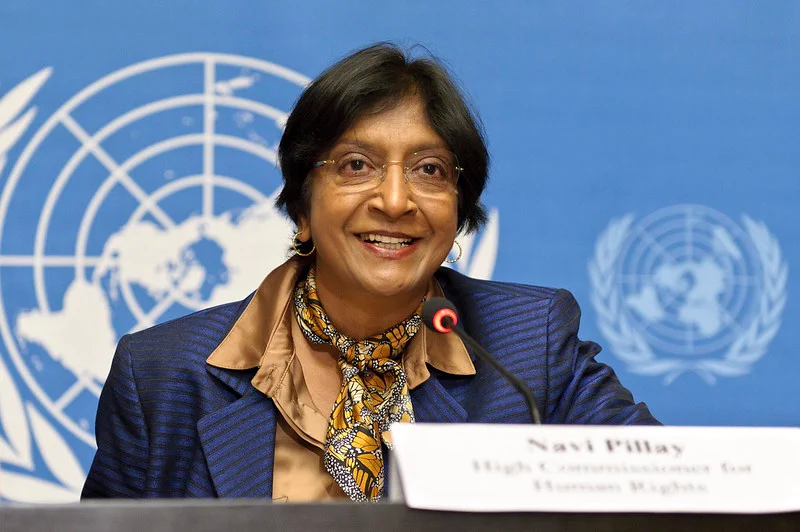
The African Bar Association (AfBA) has congratulated renowned South African jurist and former United Nations High Commissioner for Human Rights, Judge Navanethem “Navi” Pillay, on winning the 2026 Nobel Peace Prize.
In a congratulatory message issued on Friday, October 9, 2026, from New York, United States, AfBA President, High Chief Ibrahim Eddy Mark, described the recognition as a momentous achievement for Pillay and a source of inspiration to the African and international legal communities.
The Norwegian Nobel Committee announced Pillay as the 2026 Nobel Peace Prize laureate in recognition of her longstanding contributions to peace, international law, justice and the protection of human rights.
AfBA described the distinguished jurist as an internationally respected advocate whose decades of service had helped advance accountability, equality and human dignity across the world.
The association particularly recalled Pillay’s participation as a keynote speaker at its Renaissance Conference held in Harare, Zimbabwe, in 2016.
According to AfBA, her participation as keynote speaker at that historic gathering remains a cherished memory and reflects the association’s longstanding relationship with distinguished international personalities committed to justice and the rule of law. The association recalled that she was also honoured with an AfBA Medal of Merit in Leadership, during its 2023 Annual Conference held in South Africa.
The association noted that Pillay’s remarkable professional journey had continued to inspire legal practitioners, judicial officers, human rights defenders and younger generations across Africa and beyond.
Judge Pillay made history as the first non-white Judge appointed to the High Court of South Africa. She subsequently served as United Nations High Commissioner for Human Rights, where she played a significant role in advancing the global human rights agenda. Throughout her distinguished career, she has consistently championed justice, accountability, equality, and the protection of fundamental freedoms.
She subsequently served at the International Criminal Tribunal for Rwanda, where she contributed to the development of international criminal law and accountability for grave human rights violations.
Her distinguished career also included service as a judge of the International Criminal Court and as United Nations High Commissioner for Human Rights from 2008 to 2014.
Throughout these appointments, she remained a prominent voice in international efforts to combat discrimination, protect fundamental freedoms and ensure accountability for serious violations of international law.
AfBA said her selection for the Nobel Peace Prize underscored the importance of strengthening international legal institutions and recognising individuals who have dedicated their careers to defending justice and human dignity.
The association commended Pillay’s enduring contributions to humanity and her continued advocacy for peaceful coexistence among nations and peoples.
It further noted that her achievements demonstrated the significant role African jurists could play in shaping international legal standards and promoting justice beyond the continent.
AfBA expressed pride in its association with Pillay, particularly her contribution to its 2016 Renaissance Conference, which brought together members of the legal profession and other stakeholders to discuss issues affecting Africa and the international community.
The association joined the global legal community in celebrating her recognition, describing her career as an enduring example of commitment to justice, accountability and the protection of fundamental human rights.