

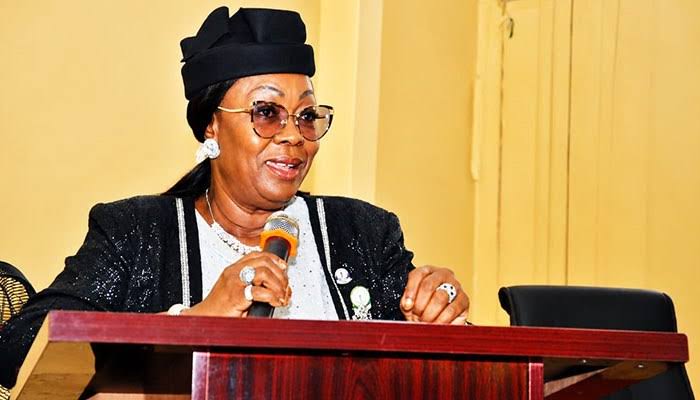
Hon. Justice Uchechukwu Onyemenam has called on African governments, judiciaries and legal institutions to embrace Artificial Intelligence responsibly, warning that technological advancement must never be allowed to undermine human dignity, fundamental rights or judicial independence.
Justice Onyemenam made the call in a keynote address titled “Harnessing Artificial Intelligence: Women as Catalysts for Security Reform, Economic Stability, and Sustainable Development in Africa,” delivered at the African Bar Association Women Forum (AFBAWF) session held on the sidelines of the AfBA 2026 Annual Conference in Cape Verde.
She said AI had moved beyond science fiction and was already transforming governance, commerce, healthcare, education, security, judicial administration and international relations, making it imperative for Africa to determine whether it would shape the transformation or remain largely a consumer of technologies developed elsewhere.
According to the jurist, the question was particularly important for African women, who must decide whether they would merely participate in the technological transformation or take leading roles in determining its direction.
“The question before Africa is therefore no longer whether Artificial Intelligence will transform our societies. The real question is whether Africa, especially the African woman will shape that transformation, or simply become a passive consumer of technologies designed elsewhere,” she said.
Justice Onyemenam expressed concern over the underrepresentation of women in artificial intelligence research, data science, cybersecurity, software engineering and digital policy formulation.
She argued that the disparity went beyond representation and raised fundamental questions of justice because AI systems learn from data which may contain historical biases.
According to her, excluding women from the design of technological systems, creation of datasets, regulation of algorithms and supervision of their implementation could result in technology reproducing existing discrimination while appearing neutral.
“An algorithm may not possess prejudice. But the data upon which it learns may,” she said, adding that diversity must extend beyond courtrooms to laboratories, innovation hubs, regulatory agencies and legislative chambers.
Turning to Africa’s security challenges, Justice Onyemenam said responsibly deployed AI could improve threat detection, intelligence gathering and responses to terrorism, violent extremism, cybercrime, human trafficking, piracy, kidnapping, money laundering, election violence and cross-border organised crime.
She identified predictive analytics, AI-assisted forensic technologies, financial intelligence, satellite intelligence and cybersecurity systems as some of the tools that could strengthen security institutions.
However, she cautioned that the deployment of such technologies raised important constitutional questions concerning privacy, mass surveillance, judicial oversight, proportionality and fundamental rights.
“Security without liberty becomes oppression. Liberty without security becomes instability. The rule of law requires both,” she said.
She stressed that women lawyers and judges had an important responsibility to ensure that security innovation did not become a justification for arbitrary governmental power.
On the administration of justice, the Court of Appeal Justice said AI could help African judiciaries address persistent challenges including case backlogs, manual record keeping, delayed proceedings, inadequate legal aid and limited public access to legal information.
She said intelligent case-management systems could reduce delays, while AI-assisted transcription, language translation, electronic legal research and digital evidence management could improve efficiency and access to justice.
Justice Onyemenam, however, drew a clear line between using AI to assist the courts and allowing technology to replace judicial reasoning.
She said judging involves wisdom, context, compassion, constitutional interpretation, human experience and moral judgment — qualities that cannot simply be delegated to machines.
“An algorithm may recommend. Only a judge should decide.”
She added that AI should remain an instrument for improving judicial efficiency rather than becoming a substitute for judicial conscience.
Justice Onyemenam also highlighted AI’s potential contribution to economic stability, particularly through precision agriculture, financial technology, healthcare innovation, smart manufacturing, logistics, climate adaptation and digital commerce.
She said women entrepreneurs could benefit significantly from AI-powered financial inclusion, digital identity systems, smart agricultural technologies, predictive market analytics and digital legal platforms.
But she stressed that technological innovation alone would not guarantee economic transformation, arguing that Africa needs strong regulatory institutions, reliable digital infrastructure, effective consumer protection, cybersecurity legislation, cross-border data governance and confidence in the rule of law.
“Economic growth cannot flourish where legal uncertainty prevails,” she said, noting that investors require predictability, integrity, independent courts and enforceable contracts.
On regulation, Justice Onyemenam called for human-centred AI governance anchored on dignity, equality, privacy, accountability, transparency and non-discrimination.
She cautioned against simply importing foreign regulatory models without taking account of Africa’s particular circumstances and values.
According to her, African regulatory frameworks should recognise the continent’s informal economies, linguistic diversity, customary legal traditions, community-based governance, development priorities, continental integration and the aspirations of Agenda 2063.
She challenged African women to play a leading role in ensuring that technology incorporates African perspectives and preserves the continent’s identity.
The jurist also identified the African Continental Free Trade Area as an important vehicle for developing Africa’s digital economy.
She said the continent’s AI sector could not thrive within fragmented legal systems and called for greater harmonisation of regulations governing electronic transactions, cybersecurity, digital taxation, consumer protection, intellectual property, cross-border data transfers and digital dispute resolution.
Women legal professionals, she said, should take leading roles in shaping these reforms to ensure Africa’s emerging digital economy is not only technologically advanced but socially just.
Justice Onyemenam further called for increased investment in AI education and capacity building, saying universities should incorporate artificial intelligence, digital governance, cyber law and technology ethics into legal education.
She urged judicial institutes to provide continuous training on emerging technologies, while Bar Associations should establish specialised AI committees. Governments, she added, should promote collaboration among lawyers, engineers, economists, ethicists, data scientists and policymakers.
She advocated mentorship programmes, research grants, scholarships, technology incubators, digital literacy initiatives and greater representation of women at decision-making tables, describing such investments not as charity but as investments in Africa’s future.
Concluding, Justice Onyemenam set out a five-point call to action, urging African governments to develop AI strategies rooted in constitutionalism and human rights; judiciaries to adopt responsible technology without sacrificing independence; universities and professional institutions to strengthen education and research; deliberate investment in women as leaders in AI and digital governance; and a continued focus on humanity as the ultimate purpose of technological development.
She said history would judge the present generation not merely by whether it witnessed the rise of artificial intelligence, but by whether it governed the technology wisely, protected fundamental rights, strengthened democratic institutions and empowered women to lead.
Justice Onyemenam ended with a challenge for Africa to ensure that justice and human dignity are embedded in the continent’s technological future and that women are not merely represented in that future but help design it.
“When the history of Africa’s artificial intelligence transformation is eventually written, I do not want it to say that women were present. I want it to say that women changed the direction of the transformation,” she said.