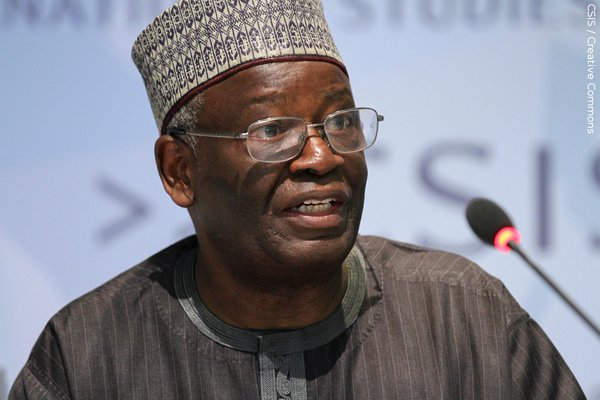
The sunlit shores of Sal Island in the Republic of Cape Verde provided the setting on Monday for what may be one of the most consequential addresses delivered to Africa’s legal community in recent years, as former United Nations Under-Secretary-General and Chief of Staff, Professor Ibrahim Agboola Gambari, CFR, opened the 2026 Annual Conference of the African Bar Association with a keynote address that was equal parts diagnosis, warning and call to arms.
The conference, themed “Resilient Africa’s Roadmap for Sustainable Development: Addressing and Strengthening Issues of Military, Security and Economic Stability,” brought together lawyers, judges, attorneys-general, justices of superior courts, representatives of the African Union and regional economic communities, members of the diplomatic corps and legal scholars from across the African continent and the diaspora.
It was, by every measure, a gathering of the continent’s finest legal minds. And what Professor Gambari told them was not comfortable.
WHY CAPE VERDE, AND WHY IT MATTERS
Professor Gambari did not choose his opening by accident. He began by holding up the host nation as a living rebuke to those who argue that African democracy cannot work.
Since its transition to multi-party democracy in 1991, Cape Verde has experienced peaceful alternations of power between its two major parties, the African Party for the Independence of Cape Verde and the Movement for Democracy, without a single military intervention, constitutional rupture, or descent into political violence.
“Cape Verde consistently ranks as Africa’s freest and most democratic nation across every credible index,” Gambari noted, pointing to its Constitutional Court, established in 2015, its independent Ombudsman institution and its Parity Law advancing women’s political representation.
“If ever there were a living testament to the proposition that African nations are fully capable of governing themselves with integrity, accountability, and respect for human rights, Cape Verde is that testament,” he said.
The implicit message was pointed: if Cape Verde can do it, the excuses made elsewhere on the continent do not hold.
ELEVEN COUPS IN SIX YEARS, AND COUNTING
Professor Gambari did not soften the security picture. He presented it in full, and the numbers were stark.
Between 2020 and the present, the African continent has witnessed at least eleven successful unconstitutional changes of government, a wave of military coups unprecedented since the turbulent decades of the 1960s and 1970s.
Mali. Guinea. Burkina Faso. Chad. Sudan. Niger. Gabon. These are not merely names on a map; they are nations of millions of people whose aspirations for democratic self-governance have been interrupted, often violently, by men in uniform who claim to rescue the state from the very failures those uniforms sometimes helped create and sustain.
In the Sahel alone- what Gambari called the “coup belt”- three consecutive military takeovers occurred in Mali in August 2020 and May 2021, in Burkina Faso in January and September 2022, and in Niger in July 2023, producing what he described as a cascading destabilisation whose effects radiate far beyond their borders.
The data that followed was arresting: the Sahel alone accounted for 51 per cent of all terrorism-related fatalities worldwide in 2024, up from 48 per cent the previous year. Five of the ten countries most affected by terrorism globally are in the Sahel.
But it was not the statistics that cut deepest. It was Gambari’s diagnosis of why the coups happened at all.
“When a population celebrates the overthrow of its own elected government,” he told the assembled lawyers, “the failure is not merely military; it is institutional, political, and even legal- in the sense of a failure of the legal profession to hold the line as it was eroded, slowly and incrementally, long before the tanks rolled in.”
He paused. Then he said it plainly: “Above all, it is a failure of constitutionalism itself.”
THE MILITARY CURE THAT WORSENED THE DISEASE
Professor Gambari, who has watched African military governments come and go across six decades of professional engagement with the continent, was withering on the claims of the current generation of coup leaders.
The arguments made by today’s coup leaders in Bamako, Ouagadougou, and Niamey are eerily, almost word-for-word, identical to those made by their predecessors sixty years ago. And the results, I can assure you from the vantage point of six decades, will be no different.
The evidence, he said, was already in. In Mali, armed conflict events rose by more than 400 per cent between 2020 and 2025 under military rule, a fact he described as demolishing the central justification for every one of the coups. The introduction of the Russia-linked Africa Corps, successor to the Wagner Group, now operating under the Russian Ministry of Defence, had not stabilised the nations it entered but had, in documented instances, been linked to grave human rights violations against the very civilian populations it was purportedly deployed to protect.
Reports from Mali document unlawful killings of civilians and forced disappearances by Malian armed forces operating alongside Wagner personnel. The 2023 Karma Massacre in Burkina Faso, in which military forces and civilian auxiliaries killed scores of unarmed villagers, stands as a chilling reminder that the cure can be worse than the disease.
Meanwhile, in Burkina Faso, Captain Ibrahim Traoré has postponed democratic elections until 2029, seven years after seizing power. In Mali, the junta has suspended political parties and censored the media. In Niger, freedom of expression has been systematically curtailed.
“These are not governments transitioning back to democracy,” Gambari said. “They are consolidating authoritarian rule under a thin veneer of revolutionary rhetoric.”
THE RULE OF LAW: AFRICA’S INDISPENSABLE FOUNDATION
Turning directly to the lawyers in the room, Gambari delivered what may have been the most consequential section of his address, a direct challenge to the African legal profession to understand its own failures and rise to its own responsibilities.
He cited the 2025 Rule of Law Index published by the World Justice Project, which found that the rule of law weakened in 28 of 38 African countries assessed, the deterioration driven by weakened regulatory enforcement, reduced transparency, growing authoritarian trends and increasing political interference in judicial systems.
But he was careful not to make decline sound inevitable. Eight African countries improved their scores. Rwanda, Namibia, and Mauritius ranked highest on the continent.
He quoted the former President of the African Development Bank, Dr. Akinwumi Adesina, with evident approval: “The rule of law is Africa’s new gold.”
The economic argument, Gambari argued, was as compelling as the moral one. No investor, domestic or foreign, will commit capital to a jurisdiction where contracts are unenforceable, where judges can be bought or intimidated, or where regulations change at the whim of a minister or at the barrel of a gun.
“You cannot build a school where a bomb may fall,” he told the delegates. “You cannot plant and harvest crops where militias patrol. You cannot attract investments where contracts are enforced by the gun rather than by the court.”
Then came the line that silenced the room: “Security without the rule of law is tyranny by another name. And there can be no durable peace without justice.”
AFRICA’S DEBT CRISIS: A STRUCTURAL INJUSTICE
Professor Gambari moved from security to economics, and found the picture no less troubling.
In 2025, Africa’s total foreign debt surpassed 1.3 trillion United States dollars. Twenty-two low-income countries in Sub-Saharan Africa are classified by the World Bank as being in, or at high risk of, debt distress.
The human cost, he said, was not abstract. In 2023, more than half of Sub-Saharan Africa’s population lived in countries that spent more on interest payments than on education and health combined. As of March 2026, a typical government in the region spent about one-seventh of its revenue on interest payments alone.
Many African nations face interest rates exceeding ten per cent, while Group of Seven countries borrow at two to three per cent. This is not merely an economic disparity; it is a structural injustice embedded in the architecture of global finance, and it must be named as such.
He called on the legal profession to confront the spectre of vulture funds, investors who buy distressed sovereign debt at a discount and then sue for full repayment in foreign courts, as a predatory dimension of Africa’s debt challenge demanding direct legal engagement.
THE AfCFTA: A GENERATIONAL OPPORTUNITY THAT LAWYERS MUST BUILD
Against the weight of the security and debt crises, Gambari pointed to one development that he described as a genuine generational opportunity: the African Continental Free Trade Area.
With 49 countries having deposited their instruments of ratification, the AfCFTA is the world’s largest free trade area by number of participating countries, creating a single market of 1.4 billion people with a combined GDP exceeding 3.4 trillion dollars.
But he directed a specific and pointed message at the lawyers in the room. The AfCFTA, he said, would only deliver its transformative promise if the legal and regulatory infrastructure was in place to support it.
“This is lawyers’ work, distinguished delegates,” he said. “This is your work. And the prosperity of a billion and a half people depends on how well and how swiftly it is done.”
AFRICA’S GEOPOLITICAL MOMENT – AND ITS LEVERAGE
Gambari addressed the growing great-power competition for African allegiance directly and without diplomatic hedging.
He acknowledged Russia’s expanding military footprint in the Sahel through the Africa Corps, China’s integration of security engagements with economic interests in critical minerals and port development, and the recalibration of US and French approaches, “often with an eye to their own strategic interests rather than Africa’s development priorities.”
But he rejected the framing of Africa as a passive chessboard.
Africa holds 30 per cent of the world’s mineral reserves, including the critical minerals essential to the global energy transition. It possesses 60 per cent of the world’s uncultivated arable land. Its young population is the world’s most dynamic demographic asset. These are not weaknesses; they are sources of extraordinary bargaining power if we have the wisdom and unity to deploy them strategically.
Every external partnership, he argued, must be evaluated against a single test: “Does it strengthen African institutions, or weaken them? Does it build African capacity, or create African dependency? Does it advance the welfare of African citizens, or serve the interests of foreign capital?”
He renewed Africa’s demand for two permanent seats on the United Nations Security Council, describing it as not merely a matter of prestige but of justice and practical necessity. A Security Council that deliberates on Sudan, Somalia, the Sahel, and the Democratic Republic of Congo without permanent African representation is an anachronism the twenty-first century can no longer afford.
TEN RECOMMENDATIONS THE CONFERENCE MUST ACT ON
Professor Gambari closed with ten concrete recommendations directed at the assembled bar associations and their governments, a roadmap, he said, rather than a wish list. They included:
- Strengthening the African Union’s anti-coup mechanisms with swifter, more calibrated responses that combine targeted sanctions with diplomatic engagement and address the governance failures that create conditions for military intervention.
- Investing heavily in judicial independence – with the African Bar Association establishing a Continental Judicial Independence Observatory to monitor and report on judicial independence across the continent.
- Accelerating AfCFTA implementation, with the legal profession taking a leading role in finalising rules of origin, dismantling non-tariff barriers and building African-seated arbitration institutions.
- Establishing a Pan-African Credit Rating Agency so that Africa is no longer at the mercy of credit-rating methodologies designed in New York and London that systematically raise borrowing costs for African nations.
- Reforming the global debt architecture, including mandatory participation by private creditors in sovereign debt restructuring and robust legal protections against vulture fund litigation.
- Expanding access to justice across the continent through pro bono services, legal aid, mobile courts, digitised case management and AI-assisted legal information services.
- Protecting civic space and press freedom – with lawyers at the forefront of defending freedom of expression, assembly and the press as essential democratic infrastructure.
- Domesticating continental instruments- including the African Charter on Democracy, Elections and Governance and the AfCFTA Protocols, into enforceable national law.
- Investing in the next generation of African lawyers, with reformed law school curricula covering international trade law, digital governance, climate litigation and human rights advocacy.
- Building permanent continental legal networks, with the African Bar Association establishing working groups on security sector reform, economic governance, digital rights, climate justice and gender equity, producing annual reports to inform continental decision-making.
THE CLOSING: “ALUTA CONTINUA”
Professor Gambari ended where he began, with honesty.
Invoking the great liberation leader Amílcar Cabral, a son of Guinea-Bissau and Cape Verde, he quoted the words that have defined African resistance for generations: “Tell no lies. Claim no easy victories.”
“I have tried, in this address, to heed that counsel,” he said. “I have spoken frankly about the severity of the challenges we face, the coups, the terrorism, the debt, the democratic backsliding, and the geopolitical pressures, while claiming no easy victories.”
But he did not end in despair.
“I stand before you, following a long career in the service of this continent in various capacities, with a conviction deepened with each passing decade that while ‘aluta continua,’ Africa will prevail. Not because it is destined to do so, but because it has the people, the talent, the resources, and, most critically, the growing institutional and legal capacity to shape its own future.”
The applause that followed, witnesses said, was long.