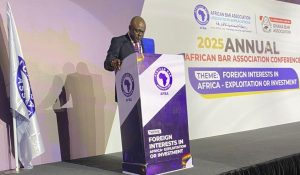


Dr. Tony Okechukwu Ojukwu, SAN, OFR, Executive Secretary of Nigeria’s National Human Rights Commission, presented a thought-provoking paper at the African Bar Association Conference. Speaking on “Global Influence on Africa’s Human Rights Frameworks,” he explained that Africa’s relationship with international human rights laws is active and complex. It involves adopting, adapting, and sometimes resisting global standards to reflect African realities.
Dr. Ojukwu said Africa does not simply copy international human rights models. Instead, the continent adjusts them to fit its history, culture, and stage of development. He cited the African Charter on Human and Peoples’ Rights as an example of this approach. The Charter, he noted, combines universal rights with uniquely African values such as community, responsibility, and shared progress. This shows how Africa can take global ideas and make them its own without losing its identity.
He also noted that Africa’s resistance to some global pressures, especially political or governance models imported from the West, is not rebellion but self-protection. According to him, countries should not be forced to accept systems that ignore their local realities. True progress, he said, must come from dialogue and home-grown solutions, not from imposed models that fail to reflect African experiences.
Dr. Ojukwu further highlighted Africa’s contributions to global human rights thinking. He said Africa has offered new perspectives, especially through the principle of Ubuntu — a philosophy that values human connection, community, and mutual care. Concepts like the right to development and collective rights, he said, are examples of Africa’s influence on international law and its push for fairness that benefits both individuals and societies.
In closing, Dr. Ojukwu described Africa’s human rights vision as “contextual universalism” — meaning universal rights adapted to local realities. He urged stronger political commitment, better training, and regional collaboration to improve implementation. As global challenges evolve, he said, Africa’s example shows that human rights work best when shaped by the people and cultures they are meant to protect.